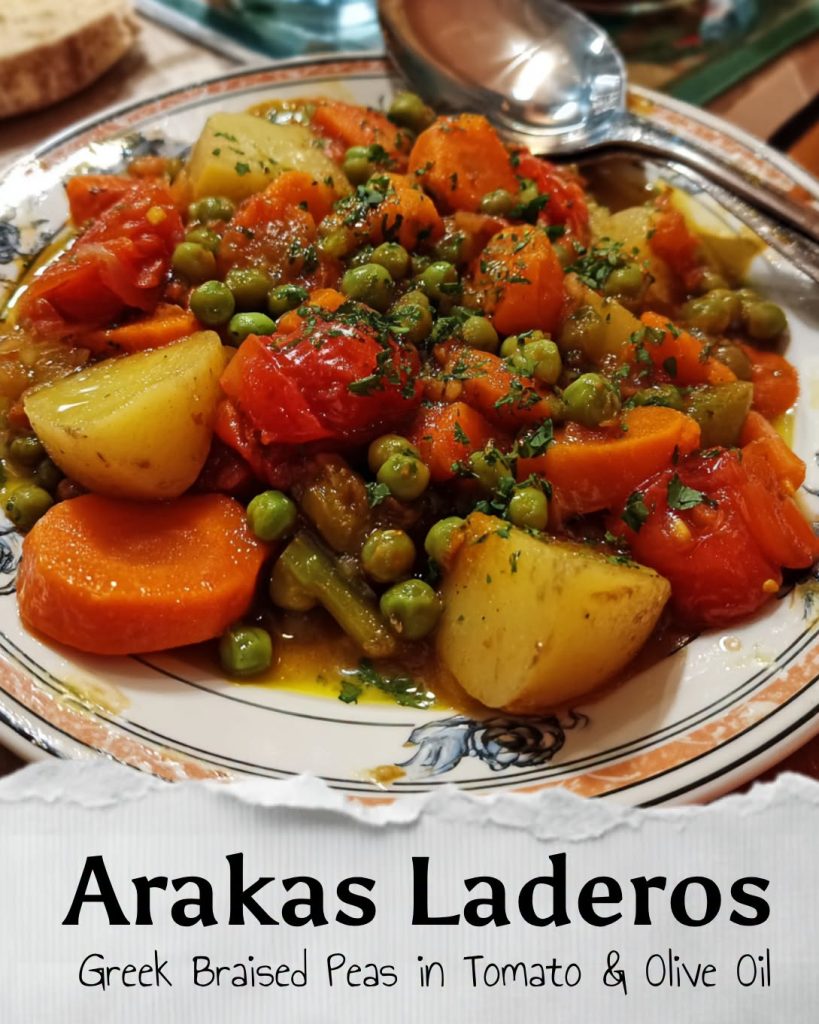
Arakas laderos is a classic example of Greek ladera, a family of vegetable dishes slowly cooked with generous olive oil and tomato. The finished dish is soft and spoonable, with sweet peas, tender carrots, and creamy potatoes surrounded by a rich sauce that tastes both fresh and deeply savory.
The aroma begins with onion softening in olive oil, followed by tomato, dill, and a gentle hint of garlic. As everything simmers together, the vegetables release their natural sweetness, while the potatoes absorb the seasoned sauce and help give it a lightly thickened consistency.
This is the kind of practical one-pot meal I appreciate on busy evenings. Most of the work happens at the beginning, and once the pot is simmering, it needs only an occasional stir. My family especially enjoys it with warm bread for soaking up every bit of the tomato and olive oil sauce.
Although it is often served as a meatless main course in Greece, it also works beautifully as a vegetable side. Letting it rest before serving is worth the extra few minutes because the sauce settles, the olive oil becomes more aromatic, and the flavors taste more balanced.
Love this recipe? Pin it to your Mediterranean Dinner board on Pinterest so you do not lose it!
Why You’ll Love This Recipe
- Comforting Without Feeling Heavy: Potatoes and olive oil make the dish satisfying, while peas, carrots, tomato, and herbs keep it bright.
- Simple One-Pot Cooking: The entire recipe comes together in one wide pot, which keeps both preparation and cleanup manageable.
- Naturally Plant-Based: No specialty vegan substitutes are needed because the traditional combination is already dairy-free and meat-free.
- Budget-Friendly Ingredients: Frozen peas, carrots, potatoes, canned tomatoes, and pantry seasonings create a generous family meal at a modest cost.
- Delicious at Several Temperatures: Arakas laderos may be served warm, at room temperature, or gently reheated, making it useful for both weeknight dinners and relaxed gatherings.
Key Ingredients & Why
- Extra-Virgin Olive Oil: Olive oil is not merely a cooking fat in a ladero dish. It carries the flavor of the dill, tomato, onion, and garlic, while giving the sauce its characteristic silky body.
- Green Peas: Peas contribute sweetness and plant protein. Frozen peas are especially reliable because they are picked and frozen quickly, preserving their color and tender texture.
- Crushed Tomatoes: Tomatoes provide acidity, glutamates, and natural sugars that balance the richness of the olive oil and deepen during simmering.
- Yukon Gold Potatoes: Their moderately waxy texture allows them to become creamy without falling apart as easily as high-starch baking potatoes.
- Fresh Dill: Dill supplies the fresh, grassy aroma closely associated with this dish. Adding part during cooking and part near the end preserves both depth and freshness.
- Lemon Juice: A small amount added after cooking sharpens the sauce and balances the natural sweetness of the peas and carrots without making the dish taste distinctly lemony.
Variations & Substitutions
- Fresh Peas: Replace frozen peas with shelled fresh peas at a 1:1 ratio. Add them during the final 15 to 20 minutes because fresh peas can lose their color and delicate texture during prolonged cooking.
- Different Waxy Potatoes: Substitute red potatoes for Yukon Gold potatoes at a 1:1 weight ratio. Cut them into the same size pieces so they cook evenly.
- More Carrots, No Potatoes: Replace the potatoes with an equal weight of additional carrots for a lighter version. The sauce will be thinner because carrots do not release as much starch, so simmer uncovered for an extra 5 minutes if needed.
- Parsley Accent: Replace up to half of the dill with an equal volume of chopped flat-leaf parsley. Keep at least half of the dill to preserve the dish’s recognizable Greek character.
- Fresh Tomato Version: Replace the 15-oz can of crushed tomatoes with 2 cups peeled, grated ripe tomatoes. Simmer the tomatoes for an additional 5 to 8 minutes before adding the remaining vegetables to evaporate excess water.
Equipment Needed
- 5- to 6-qt wide Dutch oven or heavy pot: A wide base promotes even simmering and allows excess liquid to reduce efficiently. A deep, heavy skillet with a lid may be used instead.
- Tight-fitting lid: The lid traps enough steam to cook the potatoes and carrots evenly. Do not use a loose sheet of foil over a gas flame because it may shift or become damaged.
- Liquid measuring cup: Accurate water measurement helps prevent a soup-like sauce or vegetables that scorch before becoming tender.
Yield & Exact Sizing
- Total Yield: About 8 cups, enough for 4 generous main-dish servings or 6 side-dish servings.
- Portion Size: Plan on approximately 2 cups per main-dish serving or 1⅓ cups per side-dish serving.
- Vegetable Size: Cut the potatoes into 1-inch cubes, slice the carrots about ⅓ inch thick, and chop the onion into ¼-inch pieces.
- Cooking Shrinkage: The vegetables lose little physical volume, but the sauce reduces by approximately 20% to 25% as it simmers and rests.
Ingredients
For the Arakas Laderos:
⅓ cup extra-virgin olive oil
1 large yellow onion, finely chopped
2 medium carrots, sliced ⅓ inch thick
2 cloves garlic, minced
1 tbsp tomato paste
1 can (15 oz) crushed tomatoes
1½ cups water, plus more as needed
1 tsp kosher salt, plus more to taste
½ tsp freshly ground black pepper
1½ lb Yukon Gold potatoes, peeled and cut into 1-inch cubes
1 lb frozen green peas
⅓ cup fresh dill, finely chopped and divided
1 tbsp fresh lemon juice
Instructions
- Soften the onion and carrots. Heat the olive oil in a 5- to 6-qt Dutch oven over medium heat. Add the onion and carrots, then cook for 7 to 9 minutes, stirring occasionally.
- Add the garlic and tomato paste. Stir in the garlic and tomato paste. Cook for about 1 minute, stirring continuously so the garlic does not brown.
- Build the tomato sauce. Pour in the crushed tomatoes and water. Add the salt and black pepper, then stir until the tomato paste is fully incorporated.
- Simmer the potatoes. Add the potatoes and half of the dill. Bring the liquid to a gentle boil, reduce the heat to medium-low, and cover the pot. Simmer for 15 minutes, stirring once or twice.
- Add the peas. Stir in the frozen peas. Cover and continue simmering for 15 to 20 minutes, or until the potatoes and carrots are tender.
- Reduce the sauce. Remove the lid and simmer for 5 to 10 minutes, stirring gently, until the sauce lightly coats the vegetables. Add 2 to 4 tbsp water if the pot becomes dry before the potatoes are tender.
- Finish and rest. Remove the pot from the heat. Stir in the lemon juice and remaining dill, then taste and adjust the salt. Let the dish rest uncovered for 10 to 15 minutes before serving.
Visual & Tactile Cues
- Sautéing Stage: The onions should look translucent and soft, not deeply browned. The carrots will appear glossy, and the pot should smell sweet and aromatic.
- Tomato Base: After the tomato paste cooks, it should darken slightly from bright red to brick red. Once the crushed tomatoes are added, the sauce should look smooth and loose enough to flow around the potatoes.
- Covered Simmer: The liquid should bubble gently around the edges rather than boil aggressively. A hard boil can break the potatoes and cause the sauce to reduce before the vegetables soften.
- Potato Doneness: A paring knife should slide into the center of a potato cube with very little resistance. The potatoes should hold their shape when stirred.
- Finished Sauce: The sauce should cling lightly to the peas and potatoes, with a small amount of seasoned olive oil visible around the edges. It should be saucy, but not watery or soupy.
- After Resting: The sauce will become slightly thicker, glossier, and more cohesive as the potatoes absorb some of the liquid.
Cooking Notes (Pro Tips)
- Keep the Simmer Gentle: Vigorous boiling can burst the peas, break down the potatoes, and leave the dish looking muddy rather than vibrant.
- Stir From the Bottom Carefully: Use a broad folding motion once the potatoes are tender. Frequent or forceful stirring can mash them into the sauce.
- Watch the Liquid Level: Different potato varieties and pot shapes absorb or evaporate water at different rates. Add a small splash of hot water when needed rather than pouring in a large amount at once.
- Do Not Rush the Rest: Resting allows the starches and olive oil to settle into the tomato sauce. The dish will taste fuller and less sharply acidic after 10 to 15 minutes.
Storage & Reheating Guide
- Refrigerator: Cool leftovers and refrigerate them in a covered, shallow container within 2 hours. Store for up to 4 days.
- Freezer: Freeze in airtight containers for up to 2 months. Leave about ½ inch of headspace for expansion. The potatoes may become slightly softer after thawing, but the flavor will remain good.
- Stovetop Reheating: Reheat over medium-low heat with 1 to 2 tbsp water per serving. Cover for the first few minutes, then stir gently until the center reaches 165°F / 74°C.
- Microwave Reheating: Place one portion in a microwave-safe bowl, cover loosely, and heat in 60-second intervals, stirring gently between intervals. This dish reheats well in the microwave because it is intended to remain soft and saucy.
- From Frozen: Thaw overnight in the refrigerator before reheating for the most even texture. Avoid reheating a large frozen block directly on high heat because the sauce can scorch before the center warms.
Serving Suggestions
This dish is especially well suited to a casual family dinner, a meatless lunch, or a relaxed Mediterranean-style spread.
- Crusty Country Bread: Bread provides the easiest way to enjoy the tomato and olive oil sauce. Warm it briefly while the finished dish rests.
- Greek Village Salad: Tomatoes, cucumber, red onion, olives, and a splash of vinegar add cool crunch and acidity. The salad can be assembled while the peas simmer.
- Marinated White Beans: A simple bowl of white beans dressed with lemon and herbs adds protein without competing with the dill and tomato flavors.
- Plant-Based Tzatziki or Plain Tzatziki: A cool, garlicky yogurt sauce provides a creamy contrast. Choose plant-based yogurt to keep the full meal vegan.
- Fresh Orange Slices with Cinnamon: This light, no-cook dessert refreshes the palate after the rich olive oil sauce and requires no additional stove or oven space.
Nutrition Facts
Estimated Nutrition per Serving
- Calories: 300 kcal
- Fat: 13 g
- Carb: 41 g
- Protein: 8 g
Disclaimer: This nutritional information is an estimate provided by an online calculator and is meant for informational purposes only.
Recipe Science
Arakas laderos is prepared by braising peas, carrots, potatoes, and onion in tomato, water, olive oil, and dill. The covered portion of cooking traps steam and transfers heat evenly into the dense vegetables, while the uncovered finish allows excess moisture to evaporate and concentrates the sauce.
Olive oil dissolves and distributes fat-soluble aroma compounds from the dill, garlic, onion, and tomato. Tomato acidity balances the sweetness of the peas and carrots, while naturally occurring glutamates increase savory depth. As the potatoes cook, some surface starch disperses into the liquid, helping the tomato sauce cling to the vegetables without flour or another thickener.
The method suits everyday cooking because most of the ingredients can be stored in the pantry, refrigerator, or freezer, and the dish requires only one pot. Gentle heat preserves the vegetables’ shape and reduces scorching. During refrigeration, potato starches firm slightly and the sauce thickens, so a small amount of water should be added during reheating to restore the original consistency.
One serving provides approximately 13 g fat, with most of it coming from olive oil. Saturated fat is expected to remain below 20% of the FDA Daily Value of 20 g. The recipe contains no added sugar, compared with the FDA Daily Value of 50 g. Sodium varies by the tomato product and salt used, but a serving prepared as written is expected to remain below 20% of the 2,300 mg Daily Value. Using no-salt-added tomatoes and reducing the kosher salt to ¾ tsp can lower sodium further without altering the cooking method.
Frequently Asked Questions
- Do I need to thaw the peas first? No. Add frozen peas directly to the simmering pot so they retain better color and structure.
- Why is my finished dish watery? The pot may have been covered for too long, or the pan may have a narrow base that slows evaporation. Simmer uncovered over medium-low heat until the liquid reduces to a spoon-coating sauce.
- Can I make arakas laderos without potatoes? Yes. Increase the carrots or peas to replace the volume, but expect a looser sauce because the potatoes normally release some thickening starch.
- Why did my potatoes fall apart? Floury potatoes, vigorous boiling, or frequent stirring can cause them to break down. Choose a waxy or all-purpose potato and maintain a gentle simmer.
- Can I use dried dill? Fresh dill produces the most characteristic flavor. When fresh dill is unavailable, use 1 tbsp dried dill in place of ⅓ cup fresh dill, adding it with the potatoes so it has time to hydrate.
- How can cooks outside the United States match the ingredients? Use any firm, waxy potato, such as Charlotte, Nicola, Maris Peer, or another boiling potato. A 400-g can of crushed tomatoes and a 450-g bag of frozen peas are close practical equivalents to the US package sizes.
- Is this dish supposed to be served hot? It may be served warm or at room temperature. Avoid serving it refrigerator-cold because the olive oil becomes less aromatic and the sauce tastes muted.
Conclusion
Arakas laderos is a lovely reminder that a few humble vegetables can become a deeply comforting meal when they are given time to simmer with tomato, dill, and good olive oil. Cooking is a journey, so adjust the sauce, herbs, and serving style until the dish feels right for your table.
Would you serve yours with crusty bread, a Greek salad, or another family favorite? Happy cooking, friend!
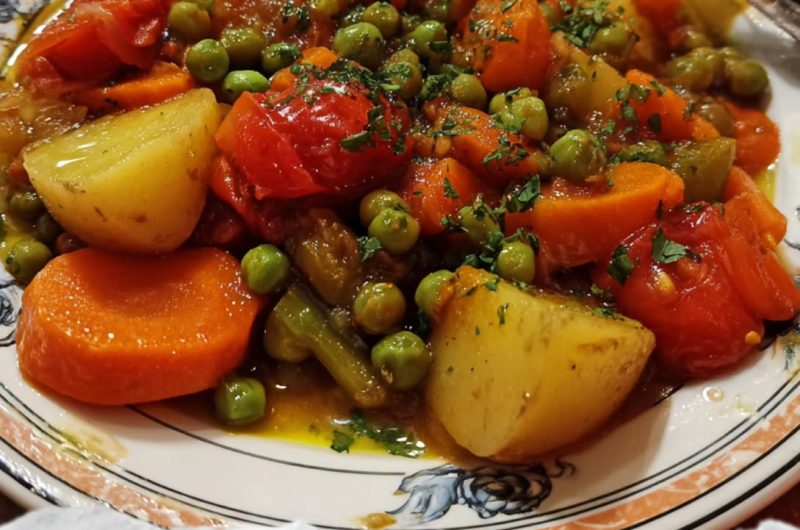
Arakas Laderos (Peas and Carrots Braised in Tomato and Olive Oil)
Course: Dinner, Side DishCuisine: GreekDifficulty: Easy4
servings15
minutes45
minutes300
kcalArakas laderos is a comforting Greek vegetable dish with tender peas, carrots, potatoes, and onions simmered in a savory tomato, olive oil, and dill sauce. It is simple to prepare, naturally plant-based, and equally satisfying warm or at room temperature.
Ingredients
⅓ cup extra-virgin olive oil
1 large yellow onion, finely chopped
2 medium carrots, sliced ⅓ inch thick
2 cloves garlic, minced
1 tbsp tomato paste
1 can (15 oz) crushed tomatoes
1½ cups water, plus more as needed
1 tsp kosher salt, plus more to taste
½ tsp freshly ground black pepper
1½ lb Yukon Gold potatoes, peeled and cut into 1-inch cubes
1 lb frozen green peas
⅓ cup fresh dill, finely chopped and divided
1 tbsp fresh lemon juice
Directions
- Soften the onion and carrots. Heat the olive oil in a 5- to 6-qt Dutch oven over medium heat. Add the onion and carrots, then cook for 7 to 9 minutes, stirring occasionally.
- Add the garlic and tomato paste. Stir in the garlic and tomato paste. Cook for about 1 minute, stirring continuously so the garlic does not brown.
- Build the tomato sauce. Pour in the crushed tomatoes and water. Add the salt and black pepper, then stir until the tomato paste is fully incorporated.
- Simmer the potatoes. Add the potatoes and half of the dill. Bring the liquid to a gentle boil, reduce the heat to medium-low, and cover the pot. Simmer for 15 minutes, stirring once or twice.
- Add the peas. Stir in the frozen peas. Cover and continue simmering for 15 to 20 minutes, or until the potatoes and carrots are tender.
- Reduce the sauce. Remove the lid and simmer for 5 to 10 minutes, stirring gently, until the sauce lightly coats the vegetables. Add 2 to 4 tbsp water if the pot becomes dry before the potatoes are tender.
- Finish and rest. Remove the pot from the heat. Stir in the lemon juice and remaining dill, then taste and adjust the salt. Let the dish rest uncovered for 10 to 15 minutes before serving.