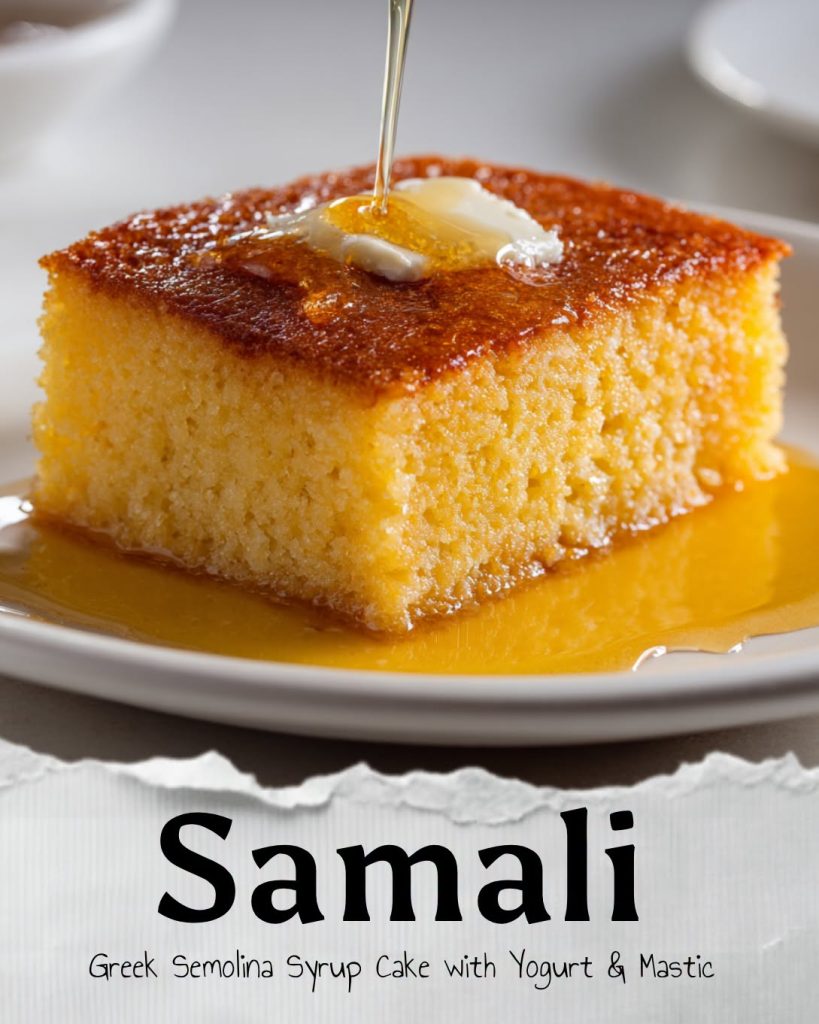
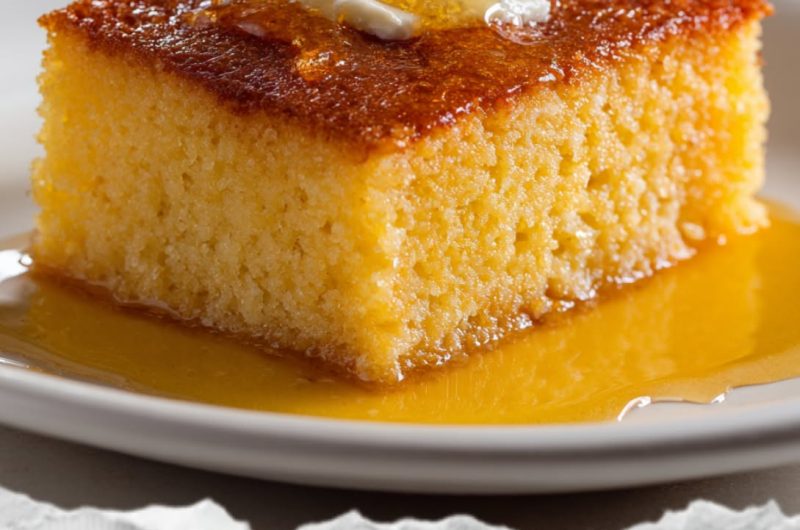
Samali is the kind of dessert that proves a simple ingredient list can produce something memorable. Coarse semolina gives the cake its characteristic slightly grainy, substantial crumb, while Greek yogurt adds moisture and a gentle tang that keeps all that syrupy sweetness from tasting one-dimensional.
What makes this cake especially distinctive is mastic. You only need a small amount, but its aromatic, lightly piney character is unmistakably Mediterranean and works beautifully with fresh lemon zest. As the cake bakes, the scored top and almonds become deeply golden, while the edges develop my favorite part, a slightly firmer, caramelized bite.
Then comes the syrup. Warm lemon-and-cinnamon syrup is poured gradually over the freshly baked cake, and the semolina eagerly absorbs it. After resting, the interior becomes moist and syrupy without turning into a soft sponge, which is exactly why coarse semolina works so well here.
This is one of those collected recipes I appreciate when I need a dessert that looks special without requiring frosting, layers, or complicated decorating. The pistachios, fresh lemon zest, and mint are simple finishing touches, but they make each piece look lovely on a serving platter.
Love this recipe? Pin it to your Greek Desserts board on Pinterest so you don’t lose it!
Why You’ll Love This Recipe
- Wonderfully Syrupy: Coarse semolina absorbs the fragrant lemon syrup while maintaining enough structure to give each slice a satisfying bite.
- Distinctively Greek Flavor: Greek yogurt, lemon, almonds, and especially mastic create a flavor profile that sets Samali apart from an ordinary semolina cake.
- No Mixer Required: The batter is simply combined in a bowl, rested, spread in the pan, and baked.
- Beautiful Without Frosting: Scored portions, whole almonds, pistachios, lemon zest, and mint give the finished cake an elegant presentation.
- Excellent Make-Ahead Dessert: The required soaking time works in your favor because the cake benefits from resting before it is cut and served.
Key Ingredients & Why
- Coarse Semolina: The larger durum-wheat particles create Samali’s characteristic textured crumb. They also absorb yogurt before baking and syrup afterward without behaving exactly like ordinary wheat flour.
- Greek Yogurt: Yogurt supplies moisture, acidity, and dairy richness. Its thick consistency helps create a substantial batter without adding eggs to this particular recipe.
- Mastic: Ground mastic provides the subtle resinous, piney, citrus-adjacent fragrance associated with many traditional Greek and Eastern Mediterranean sweets. Because it is potent, ½ tsp is enough.
- Sunflower Oil: Neutral oil supplies tenderness without competing with the delicate mastic and lemon aromas.
- Lemon: Zest perfumes the batter, while juice and peel give the syrup brightness and help balance its substantial sweetness.
- Coarse Semolina’s Resting Time: While technically a technique rather than another ingredient, the 30-minute hydration period is crucial. It gives the semolina time to absorb moisture before baking, resulting in a more cohesive crumb.
Variations & Substitutions
- Another Neutral Oil: Replace sunflower oil 1:1 with canola, grapeseed, or another mild neutral oil. Avoid strongly flavored olive oil if you want the mastic and lemon to remain prominent.
- Full-Fat or Reduced-Fat Greek Yogurt: Either can be used 1:1 by volume, provided it is thick, plain Greek-style yogurt. Avoid thin regular yogurt because it changes the batter’s hydration.
- Orange Accent: Replace the lemon zest in the cake 1:1 with finely grated orange zest for a warmer citrus note. Keep the lemon in the syrup for acidity and balance.
- Skip the Honey: The optional 1 tsp honey can simply be omitted. No replacement is necessary because the syrup already contains enough sugar for its structure.
- Nut Garnish Adjustment: If pistachios are unavailable, omit them rather than changing the cake itself. Keep the whole almonds on top when possible because they are part of Samali’s classic presentation.
Equipment Needed
- 9 x 13-inch baking dish: Provides the appropriate depth and surface area for 12 portions. A dramatically smaller pan will produce a thicker cake and require different baking time.
- Large mixing bowl: Choose one roomy enough to thoroughly hydrate the coarse semolina without spilling.
- Medium saucepan: Needed to boil and reduce the lemon-cinnamon syrup safely. Use a pan with enough headroom to prevent hot syrup from boiling over.
- Fine citrus zester: Produces finely grated zest without large pieces of bitter white pith (the fine side of a box grater can work).
- Liquid measuring cup or small ladle: Helps distribute hot syrup slowly and evenly instead of flooding one area of the cake.
Yield & Exact Sizing
- Total Yield: One 9 x 13-inch cake, cut into 12 generous pieces.
- Size & Shape: For rectangular portions, score the pan in a 3-by-4 grid. Each serving will be approximately 3 x 3¼ inches, with the exact thickness depending on the baking dish.
- Alternative Shape: Score diagonal lines before baking if you prefer the traditional-looking diamond presentation, keeping the pieces as evenly sized as possible.
- Cooking Shrinkage: Expect only modest contraction as moisture evaporates during baking. The cake may pull slightly from the edges after baking and syrup absorption.
Ingredients
For the Cake:
2⅓ cups coarse semolina
1 cup granulated sugar
1⅔ cups plain Greek yogurt
½ cup sunflower oil
2 tsp baking powder
½ tsp ground mastic
Zest of 1 lemon
1 tsp vanilla extract
Pinch of sea salt
For the Lemon Syrup:
1⅞ cups water
1¾ cups granulated sugar
Peel of 1 lemon
1 cinnamon stick
Juice of 1 lemon (about 3 tbsp)
1 tsp Greek honey, optional
For the Garnish:
12 whole blanched almonds
Chopped pistachios, as needed
Freshly grated lemon zest, as needed
Fresh mint leaves, as needed
Instructions
- Combine the dry ingredients. Add the coarse semolina, sugar, baking powder, ground mastic, and salt to a large bowl, and stir until evenly distributed.
- Mix in the wet ingredients. Add the Greek yogurt, sunflower oil, lemon zest, and vanilla. Stir thoroughly until no dry pockets remain and the batter looks uniform.
- Rest the batter for 30 minutes. Leave it at room temperature so the coarse semolina can absorb moisture from the yogurt.
- Heat the oven to 350°F / 180°C and prepare the pan. Lightly grease a 9 x 13-inch baking dish, then spread the rested batter evenly from corner to corner.
- Score and decorate the cake. Mark 12 squares, rectangles, or diamonds in the surface without cutting completely through the batter. Press one blanched almond into the center of each portion.
- Bake for 45 to 50 minutes. Place the dish in the preheated oven and bake until the cake is thoroughly golden and set through the center.
- Cook the syrup while the cake bakes. Combine the water, sugar, lemon peel, and cinnamon stick in a medium saucepan. Bring to a boil, reduce to a steady simmer, and cook for 8 to 10 minutes.
- Finish the syrup. Remove the saucepan from the heat and stir in the lemon juice and optional honey. Remove and discard the cinnamon stick and lemon peel, then let the syrup cool slightly while the cake finishes baking.
- Soak the hot cake gradually. Immediately after removing the cake from the oven, slowly pour the warm syrup across the entire surface, giving each addition a moment to soak in.
- Rest for at least 1 hour. Leave the cake undisturbed so the syrup can penetrate the semolina evenly before cutting along the original score marks.
- Garnish and serve. Finish the cooled cake with chopped pistachios, fresh lemon zest, and mint leaves, then serve at room temperature.
Visual & Tactile Cues
- Mixed Batter: The batter should be thick, moist, and easily spreadable rather than loose or pourable. There should be no visible pockets of dry semolina.
- After Resting: Expect the batter to feel noticeably thicker after 30 minutes as the semolina hydrates. This change is normal.
- Before Baking: The surface should be level, with visible score marks and the almonds sitting securely in their portions.
- Fully Baked Cake: Look for a deep golden surface, darker crisp-looking edges, and a center that feels firm rather than wet or jiggly.
- Finished Syrup: The syrup should remain fluid rather than becoming thick like caramel. Lemon and cinnamon should smell fragrant without the syrup becoming dark.
- During Soaking: The first additions of syrup may briefly pool on top but should gradually disappear into the cake.
- Ready to Serve: After resting, the pieces should cut cleanly while feeling noticeably moist and syrup-saturated inside.
Cooking Notes (Pro Tips)
- Give the Semolina Its Full Rest: Cutting the 30-minute hydration period short can leave the finished crumb noticeably coarser and less cohesive.
- Grind Mastic Finely: If using mastic crystals rather than pre-ground mastic, crush them very finely before measuring so concentrated pieces do not remain in the cake.
- Pour Syrup Gradually: Move across the entire cake instead of emptying the saucepan into the center. Even distribution is essential for consistently moist portions.
- Don’t Judge It Immediately: A freshly syruped piece does not represent the final texture. Give the cake at least 1 hour to absorb and redistribute the syrup before serving.
Storage & Reheating Guide
- Room Temperature: For short-term serving, keep the cooled cake well covered in a cool room for up to 1 day.
- Refrigerator: Store leftover Samali in an airtight container for up to 4 days. Refrigeration firms the texture, so bring individual pieces toward room temperature before serving.
- Freezer: Freeze completely cooled individual portions, tightly wrapped and placed in a freezer-safe container, for up to 2 months. Thaw overnight in the refrigerator.
- Reheating: Samali is traditionally enjoyable at room temperature and does not require reheating. If desired, warm a serving very briefly at low oven heat, but avoid prolonged heating because it can dry the syrup-soaked edges.
- Microwave: A short microwave warm-up is possible, but overheating can make the crumb overly soft and the syrup uncomfortably hot. Room-temperature serving gives the most consistent texture.
Serving Suggestions
Samali feels especially at home after a Mediterranean meal, with afternoon coffee, or on a dessert platter when you want something elegant that can be prepared ahead.
- Strong Greek Coffee: Its concentrated, slightly bitter character balances the sweet lemon syrup beautifully, and no additional kitchen work is required.
- Unsweetened Black Tea: A brisk tea cleans up the sweetness between bites while letting the cake’s mastic and citrus aromas remain noticeable.
- Plain Greek Yogurt: A small spoonful alongside each serving provides cool acidity and creaminess without adding more sweetness.
- Fresh Berries: Strawberries, raspberries, or blackberries add juicy acidity and fresh contrast to the dense, syrup-soaked semolina.
Nutrition Facts
Estimated Nutrition per Serving
- Calories: 405 kcal
- Fat: 11 g
- Carb: 72 g
- Protein: 7 g
Disclaimer: This nutritional information is an estimate provided by an online calculator and is meant for informational purposes only.
Recipe Science
Samali is a syrup-soaked semolina cake built around coarse durum-wheat semolina, yogurt, sugar, oil, and chemical leavening. Unlike a conventional flour cake, its structure and texture depend heavily on semolina hydration. Resting the mixed batter before baking allows the relatively coarse particles to begin absorbing moisture from the yogurt.
During baking, hydrated semolina starches absorb additional moisture and swell, while the proteins and starches contribute structure. Baking powder provides leavening, oil limits excessive toughness, and yogurt contributes moisture and acidity. Browning at the exposed surface produces deeper toasted flavors, while mastic and lemon supply volatile aromatic compounds. After baking, the porous semolina structure allows the lemon-cinnamon syrup to move through the cake.
This method is well suited to make-ahead preparation because syrup absorption is part of the finishing process rather than a problem to avoid. Allowing the cake to rest after soaking improves moisture distribution. For longer storage, covering the cake limits moisture loss, while refrigeration slows deterioration but also temporarily firms its texture.
The recipe contains substantial added sugar from both the cake and syrup. If the full syrup is absorbed evenly, added sugar per serving is approximately 46 g, or about 92% of the FDA Daily Value of 50 g. Saturated fat and sodium are expected to remain below 20% of their respective Daily Values, depending on the yogurt and baking powder used. For smaller portions, cutting the same pan into 18 pieces reduces the amount of added sugar consumed per piece without altering the syrup concentration or the cake’s baking chemistry.
Frequently Asked Questions
- What exactly is mastic? Mastic is an aromatic resin traditionally harvested from mastic trees, particularly those associated with the Greek island of Chios. In desserts, a very small quantity gives a distinctive resinous, piney fragrance.
- Can I make Samali without eggs? This specific recipe already contains no eggs. Its structure comes from the semolina, yogurt, and baking process rather than an egg-based cake batter.
- Why is my Samali more textured than ordinary cake? That texture is expected. Coarse semolina does not create the same fine crumb as ordinary cake flour, and its characteristic texture is part of the dessert.
- How do I find mastic outside Greece? Look for food-grade Greek mastic or Chios mastic at Greek, Mediterranean, Middle Eastern, or specialty food markets. It is also commonly sold as small resin crystals that can be finely ground before use.
- Does all the syrup really go onto the cake? The recipe is designed as a syrup-soaked dessert, so the syrup is intentionally generous. Add it gradually across the hot cake and allow enough resting time for the semolina to absorb it.
- Can I serve Samali the day after baking? Yes. Once properly covered, the rested cake is particularly convenient for next-day serving because the syrup has had plenty of time to distribute through the crumb.
Conclusion
There is something wonderfully satisfying about watching a simple pan of semolina, yogurt, lemon, and mastic turn into a golden, fragrant dessert. Cooking is always a journey, so enjoy the traditional character of this recipe while finding the presentation that feels right in your own kitchen.
If you make this Samali, I’d love to know: Do you enjoy yours with strong coffee, tea, or a spoonful of tangy Greek yogurt? Happy cooking, friend!
Samali (Greek Semolina Syrup Cake with Yogurt & Mastic)
Course: DessertCuisine: GreekDifficulty: Easy12
servings40
minutes50
minutes405
kcalThis traditional-style Greek semolina cake bakes up firm and golden before being soaked with fragrant lemon-cinnamon syrup. Greek yogurt keeps the crumb tender, while mastic gives Samali its distinctive resinous, almost pine-and-citrus aroma.
Ingredients
- For the Cake:
2⅓ cups coarse semolina
1 cup granulated sugar
1⅔ cups plain Greek yogurt
½ cup sunflower oil
2 tsp baking powder
½ tsp ground mastic
Zest of 1 lemon
1 tsp vanilla extract
Pinch of sea salt
- For the Lemon Syrup:
1⅞ cups water
1¾ cups granulated sugar
Peel of 1 lemon
1 cinnamon stick
Juice of 1 lemon (about 3 tbsp)
1 tsp Greek honey, optional
- For the Garnish:
12 whole blanched almonds
Chopped pistachios, as needed
Freshly grated lemon zest, as needed
Fresh mint leaves, as needed
Directions
- Combine the dry ingredients. Add the coarse semolina, sugar, baking powder, ground mastic, and salt to a large bowl, and stir until evenly distributed.
- Mix in the wet ingredients. Add the Greek yogurt, sunflower oil, lemon zest, and vanilla. Stir thoroughly until no dry pockets remain and the batter looks uniform.
- Rest the batter for 30 minutes. Leave it at room temperature so the coarse semolina can absorb moisture from the yogurt.
- Heat the oven to 350°F / 180°C and prepare the pan. Lightly grease a 9 x 13-inch baking dish, then spread the rested batter evenly from corner to corner.
- Score and decorate the cake. Mark 12 squares, rectangles, or diamonds in the surface without cutting completely through the batter. Press one blanched almond into the center of each portion.
- Bake for 45 to 50 minutes. Place the dish in the preheated oven and bake until the cake is thoroughly golden and set through the center.
- Cook the syrup while the cake bakes. Combine the water, sugar, lemon peel, and cinnamon stick in a medium saucepan. Bring to a boil, reduce to a steady simmer, and cook for 8 to 10 minutes.
- Finish the syrup. Remove the saucepan from the heat and stir in the lemon juice and optional honey. Remove and discard the cinnamon stick and lemon peel, then let the syrup cool slightly while the cake finishes baking.
- Soak the hot cake gradually. Immediately after removing the cake from the oven, slowly pour the warm syrup across the entire surface, giving each addition a moment to soak in.
- Rest for at least 1 hour. Leave the cake undisturbed so the syrup can penetrate the semolina evenly before cutting along the original score marks.
- Garnish and serve. Finish the cooled cake with chopped pistachios, fresh lemon zest, and mint leaves, then serve at room temperature.