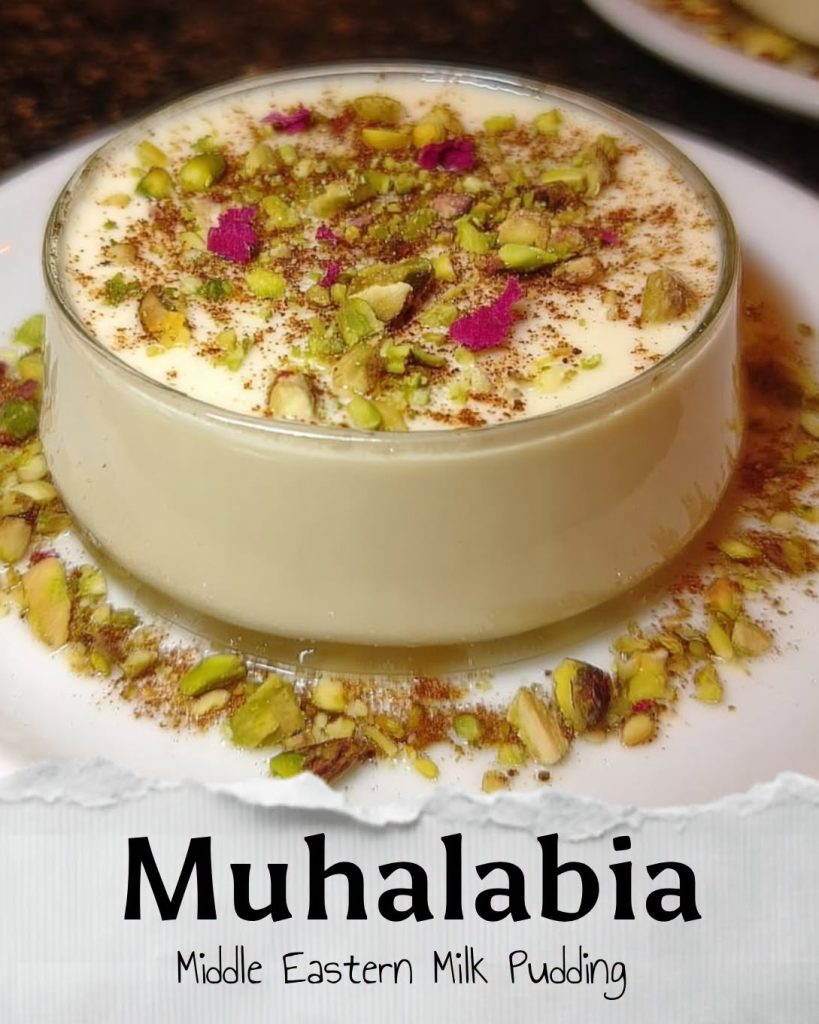
Muhalabia is one of those wonderfully simple desserts that feels far more elegant than the effort required. Whole milk and sugar create the creamy base, while rose water and orange blossom water add a delicate floral aroma that makes each chilled spoonful feel special.
The texture falls somewhere between a soft custard and a creamy pudding. Cornstarch provides the thickening, so there are no eggs to temper and no oven or water bath to manage. The biggest technique is simply whisking consistently as the pudding thickens so the finished texture stays smooth, tender, and lump-free.
I especially appreciate this collected recipe when I’m preparing dessert for a family gathering because nearly all the work happens ahead of time. Once the serving glasses are tucked into the refrigerator, dessert is essentially finished, and the garnishes can wait until everyone is ready to eat.
Pistachios bring crunch and a subtle nuttiness against the floral pudding, while shredded coconut and dried rose petals make even simple glasses look celebration-ready. It is particularly well suited to Ramadan and Eid tables, but it is easy enough to prepare whenever you want a light, fragrant finish to a meal.
Love this recipe? Pin it to your Middle Eastern Desserts board on Pinterest so you don’t lose it!
Why You’ll Love This Recipe
- Simple Stovetop Method: There are no eggs, baking, or complicated custard techniques. A saucepan and steady whisking do most of the work.
- Beautifully Creamy: Cornstarch thickens the milk into a smooth pudding that becomes softly set after chilling.
- Delicate Floral Flavor: Rose water and orange blossom water give the dessert its distinctive Middle Eastern fragrance without making it heavy.
- Made for Entertaining: Prepare the pudding at least 4 hours ahead, then garnish just before serving.
- Easy to Dress Up: Pistachios, coconut, and rose petals turn an inexpensive milk pudding into an elegant individual dessert.
Key Ingredients & Why
- Cornstarch: Cornstarch gelatinizes as the milk heats, thickening the liquid without eggs. Mixing it with cold milk first helps keep dry starch from forming stubborn lumps.
- Whole Milk: The milk provides both the body and creamy flavor of the pudding. Its fat also gives the finished dessert a rounder, richer mouthfeel.
- Rose Water: This concentrated floral water contributes the recognizable rose aroma. Adding it after cooking protects its more volatile aromatic compounds from prolonged heat.
- Orange Blossom Water: Orange blossom water contributes a citrus-floral note that complements rather than simply duplicates the rose fragrance.
- Sea Salt: A small pinch balances the sweetness and helps the milk and floral flavors taste more defined.
- Pistachios: Their nutty flavor and crisp texture contrast with the cool, soft pudding.
Variations & Substitutions
- Rose-Forward Muhalabia: Replace the 1 tbsp orange blossom water with 1 tbsp additional rose water, a 1:1 substitution. The pudding will have a distinctly stronger rose profile.
- Orange-Blossom Version: Replace the rose water with additional orange blossom water at a 1:1 ratio for a citrus-floral variation.
- Reduced-Sugar Version: Reduce the sugar from about ⅓ cup to ¼ cup. The structure will remain essentially unchanged because cornstarch, rather than sugar, is responsible for setting the pudding.
- Different Nut Garnish: Replace pistachios 1:1 by volume with finely chopped unsalted almonds when necessary. Pistachios remain the more characteristic garnish for the original version.
- Coconut-Free Garnish: Simply omit the shredded coconut rather than replacing it. It is decorative and textural, so removing it will not affect the pudding’s set.
Equipment Needed
- Medium heavy-bottomed saucepan: A 2- to 3-quart saucepan provides enough room for whisking while reducing the chance of scorching the milk.
- Balloon whisk: Essential for dispersing the cornstarch slurry evenly and maintaining a smooth pudding as it thickens.
- Small mixing bowl: Needed to combine the cornstarch with cold milk before it reaches the saucepan.
- Six 6-oz serving glasses or dessert bowls: Individual containers make chilling and serving particularly easy. Use refrigerator-safe glassware, and do not pour extremely hot pudding into fragile or non-heat-safe glass.
- Plastic wrap: Direct surface contact prevents a skin from developing while the pudding chills.
Yield & Exact Sizing
- Total Yield: About 6 individual servings, depending on how much the mixture reduces during cooking and how generously the glasses are filled.
- Serving Size: Plan on approximately ⅔ to ¾ cup pudding per person in small dessert glasses or bowls.
- Size & Shape: No shaping is required. For neat presentation, divide the pudding evenly among six approximately 6-oz dessert vessels.
- Cooking Shrinkage: Expect only minor volume loss from evaporation during the brief stovetop cooking period.
Ingredients
For the Muhalabia:
4¼ cups whole milk
⅓ cup plus 1 tbsp granulated sugar
½ cup cornstarch
¼ cup cold whole milk, for the cornstarch slurry
Pinch sea salt
1 tsp vanilla extract
1 tbsp rose water
1 tbsp orange blossom water
For the Garnish:
Chopped pistachios, as needed
Shredded coconut, as needed
Dried edible rose petals, as needed
Ground cinnamon, optional
Fresh mint leaves, optional
Instructions
- Whisk the cornstarch with ¼ cup cold milk until completely smooth. Set the slurry aside while you prepare the milk base.
- Combine 4¼ cups whole milk, the sugar, and a pinch of sea salt in a medium saucepan. Warm over medium heat, stirring regularly, just until the sugar has dissolved. Keep the milk below a full boil.
- Whisk the cornstarch slurry once more, then gradually stream it into the warm milk while whisking continuously. Continue cooking over medium to medium-low heat for about 5 to 7 minutes, stirring constantly as the pudding thickens.
- Remove the saucepan from the heat once the pudding is thick and smooth. Stir in the vanilla, rose water, and orange blossom water until evenly incorporated.
- Divide the warm pudding among six individual serving glasses or bowls. Let the strongest heat dissipate briefly, then place plastic wrap directly against each pudding surface to discourage skin formation.
- Refrigerate for at least 4 hours, or until thoroughly chilled and set. Keep the puddings refrigerated until you are ready to serve them.
- Finish each serving with pistachios, coconut, and dried rose petals. Add a light dusting of cinnamon and fresh mint, if desired, and serve cold.
Visual & Tactile Cues
- Cornstarch Slurry: The mixture should look completely milky and fluid with no visible pockets of dry cornstarch. Stir it again immediately before adding because starch settles quickly.
- Warming the Milk: Look for gentle steam and small bubbles beginning around the perimeter. Vigorous boiling is unnecessary.
- Thickening Stage: The mixture will gradually change from milk-like to noticeably creamy. Whisking should leave brief trails across the surface before they disappear.
- Finished Consistency: The hot pudding should lightly coat the back of a spoon and feel smooth rather than grainy or gelatinous.
- After Chilling: Properly set muhalabia should hold softly in the serving glass while remaining creamy enough to scoop easily with a spoon.
Cooking Notes (Pro Tips)
- Keep the Whisk Moving: Once the cornstarch enters the saucepan, continuous movement is important. Starch can thicken rapidly against the hot bottom of the pan.
- Do Not Add Dry Cornstarch Directly: Always make the cold slurry first. Adding dry starch to warm milk is one of the easiest ways to create lumps.
- Protect the Floral Aromatics: Add rose water and orange blossom water after removing the saucepan from the heat. Extended cooking can diminish their delicate aroma.
- Garnish at the Last Minute: Pistachios and coconut have better texture when they are added shortly before serving instead of sitting on the moist pudding overnight.
Storage & Reheating Guide
- Refrigerator: Cover tightly and refrigerate for up to 3 to 4 days. For the best presentation, store the pudding without its crunchy garnishes and decorate immediately before serving.
- Freezer: Freezing is not recommended. Cornstarch-thickened dairy puddings can separate or become watery and uneven after thawing.
- Reheating: Muhalabia is traditionally served chilled, so reheating is unnecessary. If refrigerated pudding has been sitting out, return it to the refrigerator rather than warming and rechilling it repeatedly.
- Make-Ahead: Preparing it the night before serving works particularly well and gives the pudding ample time to set.
Serving Suggestions
This is an especially lovely dessert for Ramadan, Eid, family dinners, or a Middle Eastern-inspired gathering because the individual portions can be completely chilled before guests arrive.
- Arabic Coffee: Its roasted, slightly bitter character provides a welcome contrast to the sweet, floral pudding, and it requires no competing kitchen equipment.
- Mint Tea: Fresh mint and hot tea provide a refreshing counterpoint to the cold, creamy dessert.
- Fresh Berries: Strawberries, raspberries, or other tart berries introduce acidity and freshness without overwhelming the rose and orange blossom aromas.
- Fresh Dates: A few dates alongside the pudding create an easy, traditional-feeling addition for a Ramadan or Eid dessert spread without requiring another cooked dish.
Nutrition Facts
Estimated Nutrition per Serving
- Calories: 190 kcal
- Fat: 6 g
- Carb: 31 g
- Protein: 6 g
Disclaimer: This nutritional information is an estimate provided by an online calculator and is meant for informational purposes only.
Recipe Science
Muhalabia is a milk-based pudding thickened primarily with cornstarch rather than eggs. Whole milk supplies water, milk proteins, lactose, and fat, while sugar sweetens the mixture. Rose water, orange blossom water, and vanilla are incorporated after thickening to provide the pudding’s aromatic profile.
Cornstarch contains starch granules that absorb water and swell as the milk reaches an appropriate temperature. This gelatinization increases viscosity and transforms the liquid milk mixture into a spoonable pudding. Continuous stirring helps distribute heat and starch evenly, while making the starch slurry with cold milk first reduces clumping. Whole milk contributes fat that makes the resulting starch gel taste creamier and less austere.
The method is practical for home cooking because it requires only brief stovetop preparation followed by refrigeration. Chilling allows the starch-thickened mixture to develop its final structure. Direct-contact covering limits surface dehydration and skin formation. Refrigeration is preferable to freezing because freeze-thaw cycles can disrupt a starch-thickened gel and encourage liquid separation.
A serving is estimated to contain roughly 190 calories, with most added sugar coming from the granulated sugar in the recipe. Dividing approximately 80 g of sugar among six portions gives about 13 g added sugar per serving, or roughly 26% of the FDA Daily Value of 50 g. Reducing the recipe’s sugar to ¼ cup can lower the added-sugar contribution while preserving the cornstarch-based structure. Whole milk contributes saturated fat, but a serving of this pudding is not expected to exceed 20% of the 20 g Daily Value. Sodium is also expected to remain well below 20% of the 2,300 mg Daily Value.
Frequently Asked Questions
- Why didn’t my muhalabia set? The starch may not have been cooked long enough to fully thicken the milk, or the cornstarch measurement may have been too low. The mixture should be clearly thick before it leaves the saucepan.
- Why did liquid collect on top of my pudding? Some separation can occur if the pudding is cooked too aggressively, held too long, or subjected to temperature fluctuations. Keep it consistently refrigerated once chilled.
- Can I make one large pudding instead of individual servings? Yes. Pour the finished mixture into a shallow serving dish and refrigerate until completely set, then garnish the surface just before serving.
- Can I leave out both floral waters? Technically, the pudding will still thicken, but it will lose the rose-and-orange-blossom character that defines this version of the recipe.
- How can I make this outside the United States? Rose water and orange blossom water are widely available at Middle Eastern, Mediterranean, South Asian, and international grocery stores. Look specifically for food-grade floral waters intended for cooking, rather than cosmetic products or concentrated fragrance oils.
- Can I prepare muhalabia the day before a celebration? Yes. It is particularly well suited to overnight refrigeration. Leave the pistachios, coconut, rose petals, and mint off until shortly before serving.
Conclusion
There is something special about a dessert that can be this simple and still look beautiful enough for a celebration. Give yourself room to adjust the garnishes and presentation as you go because cooking is a journey, and making a collected recipe fit your own table is part of the fun.
What do you love putting on top of your muhalabia, pistachios, coconut, rose petals, or all three? Happy cooking, friend!
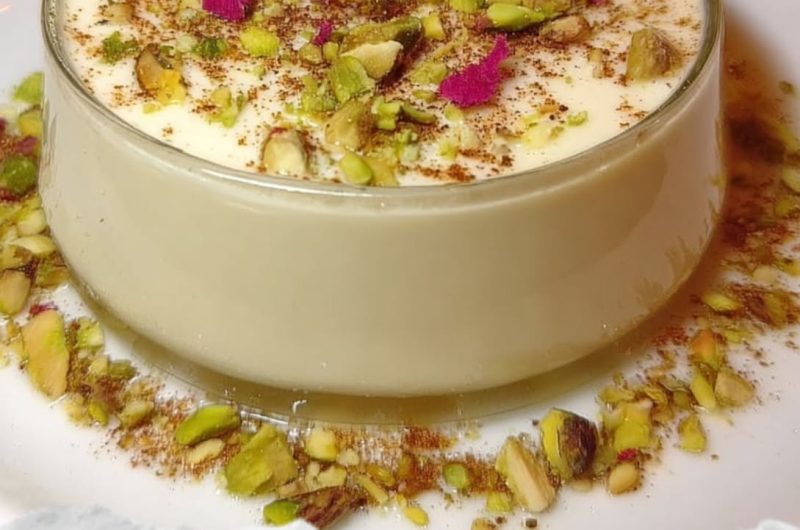
Muhalabia (Middle Eastern Milk Pudding)
Course: DessertCuisine: Middle EasternDifficulty: Easy6
servings10
minutes10
minutes190
kcalMuhalabia is a silky, chilled milk pudding delicately scented with rose water and orange blossom water. Cornstarch gives it a soft, creamy set, while pistachios, coconut, and rose petals add contrasting texture and fragrance.
Ingredients
- For the Muhalabia:
4¼ cups whole milk
⅓ cup plus 1 tbsp granulated sugar
½ cup cornstarch
¼ cup cold whole milk, for the cornstarch slurry
Pinch sea salt
1 tsp vanilla extract
1 tbsp rose water
1 tbsp orange blossom water
- For the Garnish:
Chopped pistachios, as needed
Shredded coconut, as needed
Dried edible rose petals, as needed
Ground cinnamon, optional
Fresh mint leaves, optional
Directions
- Whisk the cornstarch with ¼ cup cold milk until completely smooth. Set the slurry aside while you prepare the milk base.
- Combine 4¼ cups whole milk, the sugar, and a pinch of sea salt in a medium saucepan. Warm over medium heat, stirring regularly, just until the sugar has dissolved. Keep the milk below a full boil.
- Whisk the cornstarch slurry once more, then gradually stream it into the warm milk while whisking continuously. Continue cooking over medium to medium-low heat for about 5 to 7 minutes, stirring constantly as the pudding thickens.
- Remove the saucepan from the heat once the pudding is thick and smooth. Stir in the vanilla, rose water, and orange blossom water until evenly incorporated.
- Divide the warm pudding among six individual serving glasses or bowls. Let the strongest heat dissipate briefly, then place plastic wrap directly against each pudding surface to discourage skin formation.
- Refrigerate for at least 4 hours, or until thoroughly chilled and set. Keep the puddings refrigerated until you are ready to serve them.
- Finish each serving with pistachios, coconut, and dried rose petals. Add a light dusting of cinnamon and fresh mint, if desired, and serve cold.