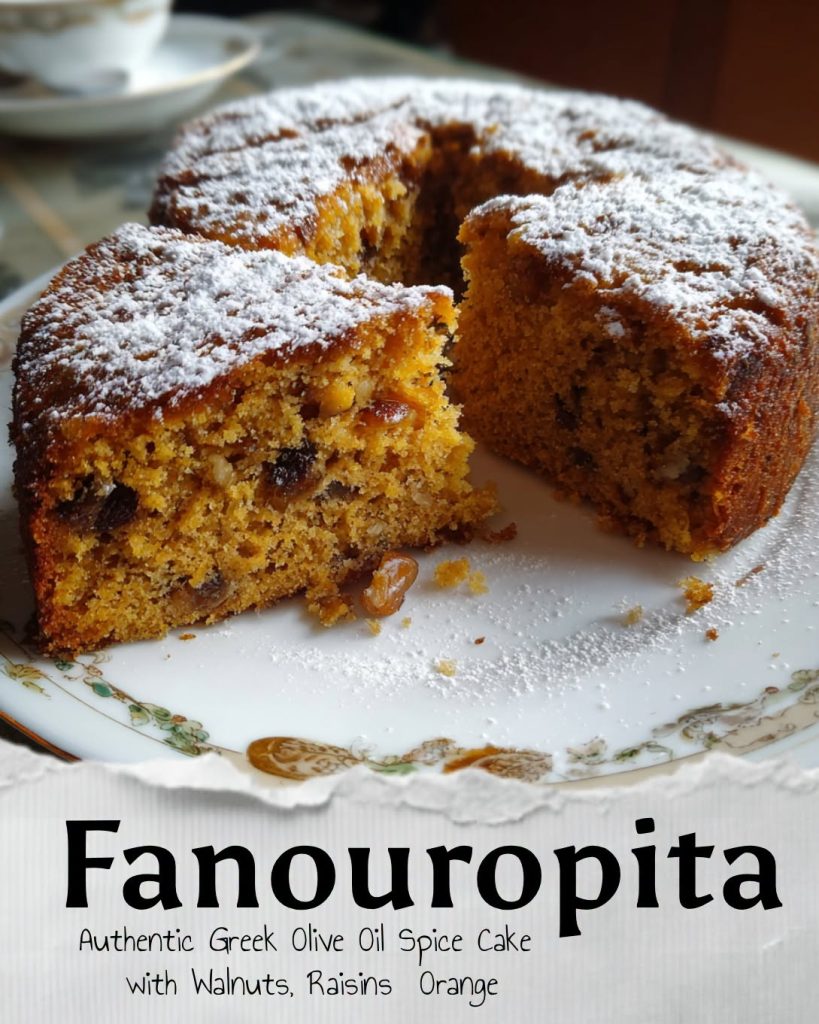
Fanouropita is a traditional Greek cake associated with Saint Fanourios, and this version has everything I want from an old-fashioned spice cake: bright citrus, warm spices, fruity raisins, crunchy walnuts, and the unmistakable richness of extra virgin olive oil. Despite that generous list of flavors, the batter is refreshingly simple and requires no mixer.
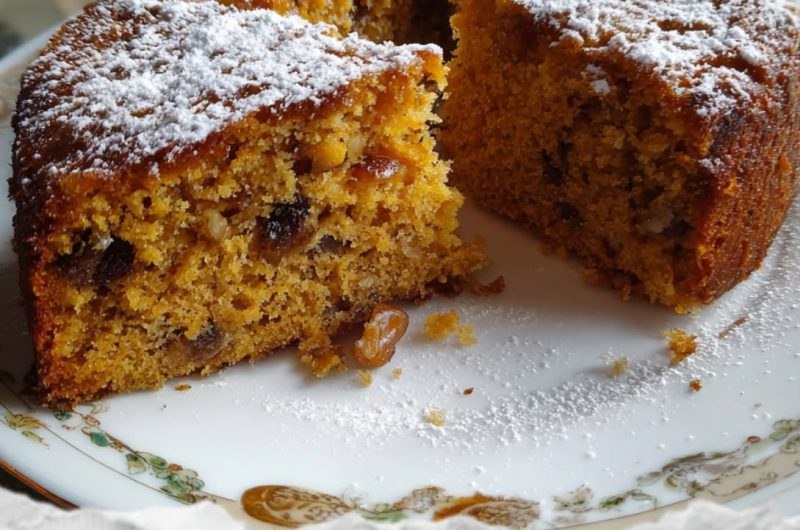
What stands out most is the texture. The orange juice and olive oil produce a moist, tender crumb, while walnuts and raisins break up each slice with contrasting crunch and chewy sweetness. Cinnamon leads the spice profile, with cloves and nutmeg adding warmth without overwhelming the fresh orange.
This is one of those collected recipes I appreciate because it feels special without creating a sink full of dishes. There are no eggs to beat, no butter to soften, and no frosting to prepare. A snowy dusting of powdered sugar, a few walnuts, and fresh orange zest are enough to make the finished cake look beautiful.
It is especially lovely alongside coffee or tea, and the citrus-spice aroma that fills the kitchen while it bakes is reason enough to make it. Love this recipe? Pin it to your Greek Desserts board on Pinterest so you don’t lose it!
Why You’ll Love This Recipe
- Naturally Egg- and Dairy-Free: Olive oil provides richness, while orange juice and water supply the liquid, so the cake needs neither butter nor eggs.
- Big Flavor, Simple Method: Orange zest, cinnamon, cloves, nutmeg, raisins, and walnuts create plenty of complexity without complicated techniques.
- No Mixer Required: A whisk and spatula handle the entire batter.
- Wonderful Texture: The crumb stays moist and tender, with chewy raisins and crunchy walnuts throughout.
- Beautiful With Minimal Decorating: Powdered sugar and a little orange zest give the cooled cake an elegant finish in minutes.
Key Ingredients & Why
- Extra Virgin Olive Oil: Olive oil supplies the cake’s fat and keeps the crumb moist without butter. Its subtle fruity character also complements orange and walnuts particularly well.
- Fresh Orange Juice and Zest: Juice contributes moisture, acidity, and sweetness, while the zest contains aromatic citrus oils that provide a much stronger orange fragrance.
- Baking Soda: The soda reacts with acidic orange juice, producing carbon dioxide that helps this eggless batter rise.
- Cinnamon and Cloves: These concentrated warm spices provide the characteristic aromatic backbone of the cake and balance the sweetness of the fruit.
- Raisins: Raisins create concentrated pockets of sweetness and a chewy contrast to the soft crumb.
- Walnuts: Their earthy flavor complements olive oil and warm spices while adding needed textural contrast.
Variations & Substitutions
- Different Raisins: Replace the raisins 1:1 by volume with golden raisins for a lighter, fruitier flavor without changing the structure of the batter.
- Pecan Variation: For a less traditional variation, replace walnuts 1:1 by volume with chopped pecans. The cake will retain a similar amount of richness and crunch.
- Milder Olive Oil Flavor: Replace up to ½ of the extra virgin olive oil 1:1 with a mild olive oil if your extra virgin oil is particularly peppery. Keeping at least half preserves the cake’s characteristic olive oil flavor.
- Skip the Nut Garnish: If desired, omit only the walnuts used for decorating and finish with powdered sugar, cinnamon, and orange zest. Keep the walnuts in the batter if you want to preserve the intended texture and flavor.
Equipment Needed
- 9-inch round cake pan: Gives the batter the appropriate depth for even baking. A similarly sized round pan may work, but avoid a substantially smaller pan because the batter can become too deep and bake unevenly.
- Large mixing bowl: Provides enough room to combine the wet and dry mixtures without overworking the batter.
- Medium mixing bowl: Needed to distribute the leaveners and spices evenly through the flour before they meet the liquid.
- Balloon whisk: Quickly combines the oil, juice, sugar, and water without requiring an electric mixer.
- Flexible spatula: Allows the flour, raisins, and walnuts to be folded in gently rather than aggressively mixed.
- Wire cooling rack: Promotes even cooling and prevents condensation from making the bottom of the cake damp.
Yield & Exact Sizing
- Total Yield: 1 round 9-inch cake, cut into 12 servings.
- Size & Shape: Bake as one approximately 9-inch round cake. For 12 portions, cut the cake into 12 even wedges.
- Serving Size: Each serving is approximately one-twelfth of the finished cake.
- Cooking Shrinkage: Expect only slight contraction around the outer edge as the cake cools. The center may settle very slightly because this is a moist, eggless cake.
Ingredients
For the Cake:
2¾ cups all-purpose flour
¾ cup plus 2 tbsp granulated sugar
¾ cup extra virgin olive oil
1 cup plus 1 tbsp fresh orange juice
⅓ cup water
1 tsp vanilla extract
1 tbsp finely grated orange zest
2 tsp baking powder
1 tsp baking soda
2 tsp ground cinnamon
½ tsp ground cloves
¼ tsp ground nutmeg
1 pinch sea salt
⅔ cup raisins
⅔ cup chopped walnuts
For the Garnish:
Powdered sugar, as needed
Chopped walnuts, as needed
Finely grated orange zest, as needed
Ground cinnamon, as needed
Instructions
- Heat the oven to 350°F / 180°C and prepare the pan. Grease a 9-inch round cake pan, then line the bottom with parchment paper for easier release.
- Whisk the liquid ingredients together. Combine the olive oil, granulated sugar, orange juice, water, vanilla, and orange zest in a large bowl until evenly blended.
- Combine the dry ingredients separately. Whisk together the flour, baking powder, baking soda, cinnamon, cloves, nutmeg, and salt so the leaveners and spices are evenly dispersed.
- Fold the dry mixture into the liquids. Add it gradually, folding only until no obvious pockets of dry flour remain.
- Fold in the raisins and walnuts. Distribute them throughout the batter with a few gentle turns of the spatula, taking care not to overmix.
- Transfer the batter to the prepared pan. Spread it evenly and gently smooth the surface.
- Bake for 45-50 minutes. Begin checking near the 45-minute mark. A skewer inserted near the center should emerge clean or with only a few moist crumbs attached.
- Cool the cake before removing it. Leave it in the pan for 10 minutes, then carefully turn it out onto a wire rack and let it cool completely.
- Finish just before serving. Dust the cooled cake generously with powdered sugar, then garnish with chopped walnuts, fresh orange zest, and a light sprinkle of cinnamon.
Visual & Tactile Cues
- Wet Mixture: After whisking, the mixture should look glossy and fairly uniform. Because oil and juice naturally resist complete emulsification, slight separation is not a problem.
- Finished Batter: Expect a thick, pourable cake batter. Stop folding as soon as the flour disappears rather than trying to make it perfectly smooth.
- During Baking: The surface should gradually become deep golden brown, and the kitchen should smell strongly of orange and warm spices.
- Doneness: The center should spring back gently when touched. A skewer should come out clean or with a few moist crumbs, but not streaked with raw batter.
- After Cooling: The cake should feel set but remain tender when sliced, with raisins and walnut pieces visible throughout the crumb.
Cooking Notes (Pro Tips)
- Measure Flour Carefully: Spoon flour into the measuring cup and level it rather than packing it down. Excess flour can make an eggless cake unnecessarily heavy.
- Do Not Overmix: Once flour becomes hydrated, excessive mixing develops more gluten and can make the crumb tougher.
- Use Fresh Orange Zest: Grate only the orange-colored outer layer. The white pith underneath can introduce unwanted bitterness.
- Cool Before Dusting: Powdered sugar quickly dissolves into a warm, moist cake. Wait until the cake is completely cool for a snowy finish.
Storage & Reheating Guide
- Room Temperature: Keep the completely cooled, ungarnished cake tightly covered for up to 2 days in a cool kitchen.
- Refrigerator: Store airtight for up to 5 days. Bring individual slices toward room temperature before serving for a softer crumb and fuller aroma.
- Freezer: Wrap individual portions securely and freeze for up to 2 months. Thaw overnight in the refrigerator, then bring to room temperature.
- Reheating: This cake is excellent at room temperature and does not require reheating. If you prefer it slightly warm, heat an individual slice very briefly at low power in the microwave. Prolonged microwaving can make the crumb rubbery or dry.
- Garnish After Storage: For the freshest presentation, add powdered sugar and orange zest after thawing or just before serving rather than before freezing.
Serving Suggestions
Fanouropita feels especially at home on an afternoon coffee table, as part of a Greek-inspired gathering, or served as a simple after-dinner sweet.
- Strong Greek Coffee: Its roasted intensity balances the sweet raisins and fragrant orange without competing with the spices.
- Black Tea: A straightforward black tea gives the cinnamon and cloves room to shine and requires no additional kitchen work.
- Fresh Orange Slices: Fresh citrus adds acidity and juiciness alongside the dense, tender cake and reinforces its orange aroma.
- Fresh Berries: Their tartness provides a refreshing contrast to the olive oil, nuts, raisins, and powdered sugar.
Nutrition Facts
Estimated Nutrition per Serving
- Calories: 380 kcal
- Fat: 18 g
- Carb: 48 g
- Protein: 4 g
Disclaimer: This nutritional information is an estimate provided by an online calculator and is meant for informational purposes only.
Recipe Science
Fanouropita relies on flour for structure, olive oil for richness, orange juice and water for hydration, and chemical leaveners for lift. Unlike cakes whose structure depends heavily on whipped or coagulated eggs, this batter develops its crumb primarily through hydrated wheat proteins and starches as they set during baking. Walnuts and raisins provide contrasting texture and concentrated flavor.
Orange juice is particularly useful in this formula because it contributes both liquid and acidity. Its acidity supports the reaction of baking soda, while baking powder provides additional leavening. Olive oil remains liquid at room temperature, helping the finished crumb retain a soft mouthfeel. Limiting mixing after the flour is hydrated reduces unnecessary gluten development and encourages tenderness.
The mixing method is practical because it requires no creaming, whipping, or temperature-sensitive butter. For storage, limiting exposure to air is important because moisture loss gradually firms the crumb, while refrigeration can further accelerate the perception of staling. Airtight wrapping and allowing chilled portions to return toward room temperature help preserve the intended eating quality.
Per serving, the estimated saturated fat and sodium are expected to remain below 20% of their respective FDA Daily Values of 20 g saturated fat and 2,300 mg sodium. Added sugar is more significant: the 180 g of granulated sugar alone provides approximately 15 g per serving before accounting for garnish, or about 30% of the FDA Daily Value of 50 g. A lighter powdered sugar garnish can limit additional added sugar without altering the cake’s baking chemistry.
Frequently Asked Questions
- Why doesn’t Fanouropita contain eggs or dairy? This formula gets its moisture and richness from olive oil, orange juice, and water, while baking powder and baking soda provide leavening. The absence of eggs and dairy is therefore intentional rather than an omission.
- Why did my raisins and walnuts sink? If the batter is unusually thin because of inaccurate measurements, heavier additions can migrate downward during baking. Accurate flour and liquid measurements help maintain the intended consistency.
- Can I make Fanouropita a day ahead? Yes. Its olive oil-based crumb holds moisture well, making it particularly suitable for preparing ahead. Wait until shortly before serving to add the powdered sugar and fresh zest.
- What if my cake browns before the middle is baked? Loosely shield the top with aluminum foil and continue baking until the center passes the skewer test. Oven calibration and differences in cake pans can affect browning speed.
- How can I make this outside the United States? The original metric quantities are especially easy to source internationally: use 350 g plain or all-purpose flour, 180 g granulated sugar, 180 ml extra virgin olive oil, 250 ml fresh orange juice, 80 ml water, 100 g raisins, and 80 g walnuts. Standard ground cinnamon, cloves, and nutmeg provide the intended spice profile.
Conclusion
This Fanouropita is the kind of cake that reminds me why simple baking can be so satisfying: a handful of familiar ingredients become something fragrant, tender, and genuinely special. Cooking is always a journey, so enjoy the tradition while finding the little finishing touches that make the recipe feel at home in your kitchen.
Have you tried Fanouropita before, and would you serve your first slice with Greek coffee or tea?
Happy cooking, friend!
Fanouropita (Traditional Greek Saint Fanourios Cake)
Course: DessertCuisine: GreekDifficulty: Easy12
servings20
minutes50
minutes380
kcalA fragrant Greek olive oil cake filled with warm cinnamon and cloves, bright orange, raisins, and walnuts. It bakes up tender and moist with a pleasantly rustic crumb and requires no eggs or dairy.
Ingredients
- For the Cake:
2¾ cups all-purpose flour
¾ cup plus 2 tbsp granulated sugar
¾ cup extra virgin olive oil
1 cup plus 1 tbsp fresh orange juice
⅓ cup water
1 tsp vanilla extract
1 tbsp finely grated orange zest
2 tsp baking powder
1 tsp baking soda
2 tsp ground cinnamon
½ tsp ground cloves
¼ tsp ground nutmeg
1 pinch sea salt
⅔ cup raisins
⅔ cup chopped walnuts
- For the Garnish:
Powdered sugar, as needed
Chopped walnuts, as needed
Finely grated orange zest, as needed
Ground cinnamon, as needed
Directions
- Heat the oven to 350°F / 180°C and prepare the pan. Grease a 9-inch round cake pan, then line the bottom with parchment paper for easier release.
- Whisk the liquid ingredients together. Combine the olive oil, granulated sugar, orange juice, water, vanilla, and orange zest in a large bowl until evenly blended.
- Combine the dry ingredients separately. Whisk together the flour, baking powder, baking soda, cinnamon, cloves, nutmeg, and salt so the leaveners and spices are evenly dispersed.
- Fold the dry mixture into the liquids. Add it gradually, folding only until no obvious pockets of dry flour remain.
- Fold in the raisins and walnuts. Distribute them throughout the batter with a few gentle turns of the spatula, taking care not to overmix.
- Transfer the batter to the prepared pan. Spread it evenly and gently smooth the surface.
- Bake for 45-50 minutes. Begin checking near the 45-minute mark. A skewer inserted near the center should emerge clean or with only a few moist crumbs attached.
- Cool the cake before removing it. Leave it in the pan for 10 minutes, then carefully turn it out onto a wire rack and let it cool completely.
- Finish just before serving. Dust the cooled cake generously with powdered sugar, then garnish with chopped walnuts, fresh orange zest, and a light sprinkle of cinnamon.